

Last summer, a Seattle homeowner paid $8,500 for a new AC system, hoping it would pay off in August.
By fall, they faced water leaking through their ceiling, and the contractor turned out to be unlicensed, uninsured, and missing.
That is not rare anymore… Seattle is warming up, and cooling systems are now standard.
With new refrigerant regulations in 2025 and HVAC companies fully booked, many contractors are cutting corners. This is important because the quality of HVAC installation affects safety, long-term costs, and your home’s health.
So, in this blog, you’ll learn:
- The 8 biggest red flags during installation
- How to verify whether a contractor is legit
- And what a proper Seattle installation looks like
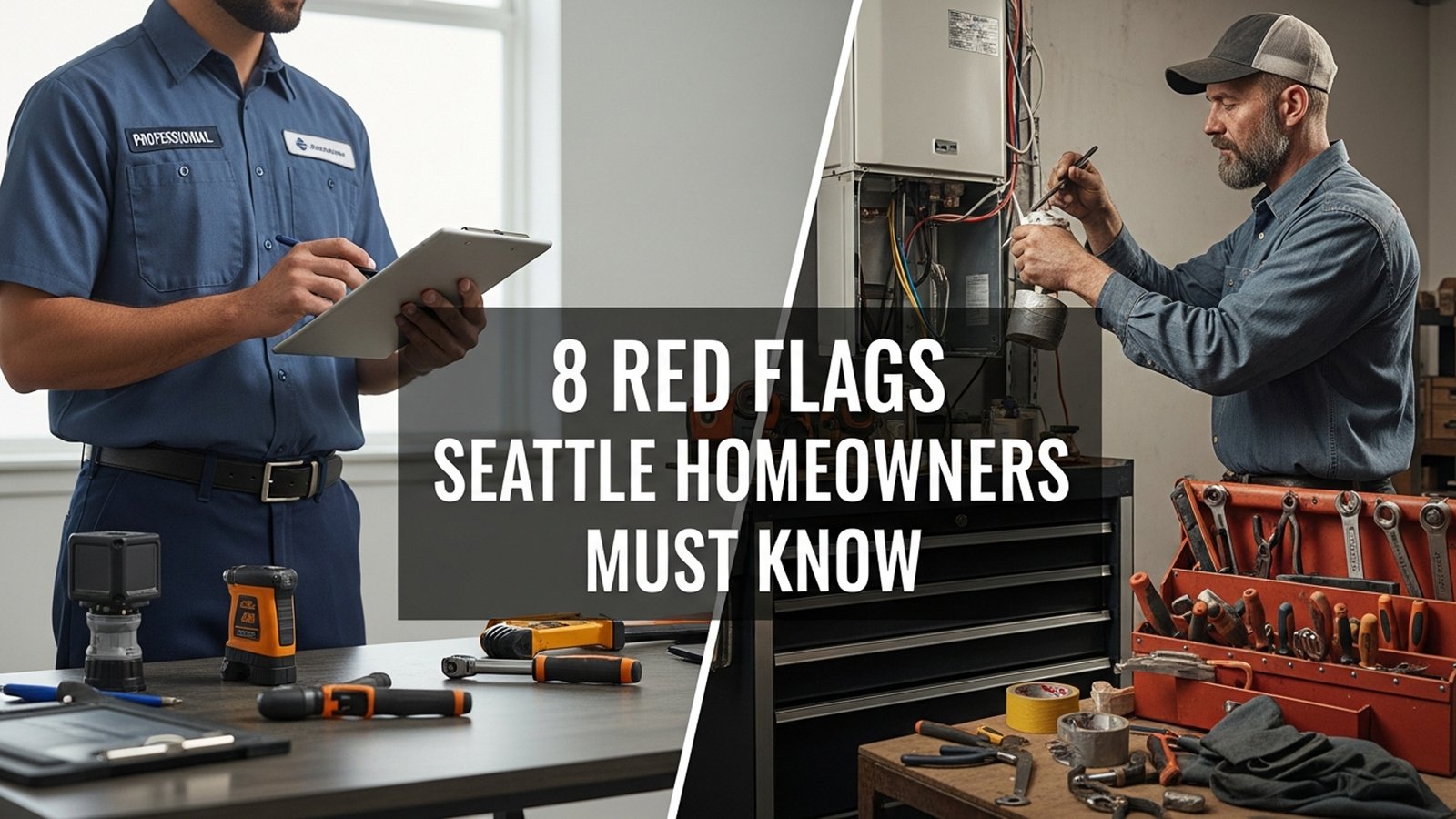
How to Spot a Bad HVAC Contractor in Seattle: 8 Critical Red Flags
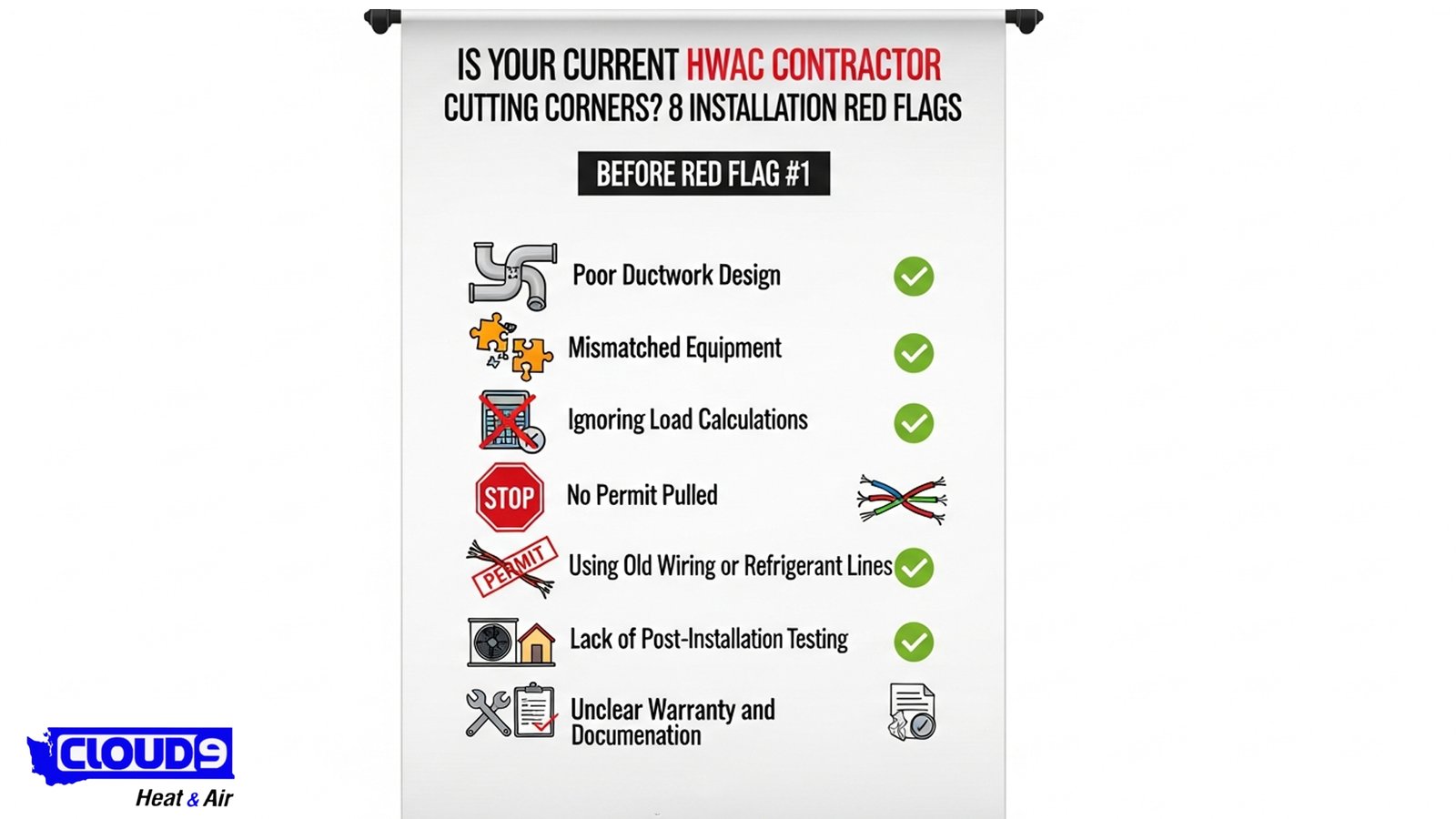
These red flags will tell you exactly what to demand from anyone who touches your home’s HVAC system.
RED FLAG #1: No Manual J Load Calculation
The biggest HVAC mistakes often start before the installation even begins. And it usually happens when a contractor skips a proper Manual J load calculation.
A lot of corner-cutters in Seattle, still size systems based on guesswork like “your house is about X square feet, so you need Y tons”. But that’s not how our climate works.
Seattle’s older homes need precise sizing. Oversized systems cause short cycling, poor humidity control, and rooms that never feel comfortable.
A real contractor will spend 1–2 hours measuring windows, insulation levels, orientation, and airflow. They’ll show their math.
What to look for:
- “Yes, we perform a Manual J.”
- They take actual measurements
They ask questions about insulation and window upgrades
Red flags:
- “We can eyeball it.”
- “Let’s just match your old system.”
Proper sizing is the main element of a good install.
RED FLAG #2: They Won’t Pull Permits
This one’s a biggie and honestly one of the easiest ways to spot a contractor who’s cutting corners.
In Seattle, every HVAC installation requires a permit. Even like-for-like replacements. Even small systems. The Seattle Department of Construction & Inspections (SDCI) tracks all of it.
So when a contractor says, “You don’t need a permit,” it’s almost always because they’re:
- Not licensed
- Trying to avoid inspections
- Skipping sales tax
- Or planning to install something, the city would fail immediately
Most homeowners don’t know that insurance companies can deny claims if the work wasn’t permitted. You could also hit friction when selling your home, or face fines up to $500 per day for unpermitted work.
A reputable contractor handles permits automatically. They schedule inspections. They show you the issued permit number. They leave a paper trail on purpose.
Green flags:
- “We pull all permits for you.”
- They show the permit number before installation.
Major red flags:
- “You can pull the permit yourself.”
- “Permits aren’t required for this job.”
If they dodge permits, walk away. No exceptions.
RED FLAG #3: No Discussion of Moisture Management
HVAC systems here deal with way more moisture than systems in places like California or Colorado. Between October and May, marine air rolls in and humidity levels stay high, which means your equipment produces 2–3x more condensate during normal operation.
If an installer doesn’t bring this up during the estimate? That’s a problem.
Moisture is something that has to be planned for in the design stage, especially in older homes, where attics and crawl spaces already struggle with dampness.
A proper Seattle installation includes:
- Secondary drain pans (critical for attic installs)
- Correct drain line slope (¼ inch per foot)
- Condensate pumps when gravity won’t cut it
- Algae prevention (UV lights or drain tablets)
Corners that bad contractors cut:
- Undersized drain lines
- No backup drainage path
- Flat or uphill drain lines that collect water
And unfortunately, those shortcuts usually show up months later, as leaks, mold, or ceiling stains.
If moisture management never comes up during the quote, that’s a flashing red warning sign.
RED FLAG #4: Not Licensed for New Refrigerants
We’re transitioning away from old refrigerants and moving to newer, mildly flammable A2L refrigerants like R-32 and R-454B.
They’re better for the environment and more efficient, but they come with new rules, handling procedures, and safety protocols. And yes, they require special training that not every contractor has.
If a contractor isn’t licensed for A2L systems, you’re taking on a risk you probably don’t even realize:
- Fire hazards
- Voided manufacturer warranties
- Failed inspections
- And installs that don’t meet Seattle or Washington state code
In Washington, a legitimate HVAC contractor should have:
- WA L&I electrical license (journey-level or trainee)
- Seattle refrigeration contractor license
- EPA 608 certification
- A2L refrigerant training (new requirement)
A good contractor won’t hesitate when you ask for credentials. They’ll show you their license numbers. They’ll explain what A2L means for your system.
Major red flag:
If they brush off A2L concerns with “It’s basically the same thing,” they’re not qualified. This is one area where you absolutely want someone who stays current with the code.
RED FLAG #5: No Heat Pump Discussion
If a contractorimmediately recommends “just replacing the furnace,” that’s a sign they’re either behind the times… or intentionally steering you toward the easier, more profitable install.
Seattle isn’t the same climate it was 10 years ago. We’re seeing more 80°+ days, more heat dome events, and way more homeowners who want cooling. Heat pumps are now one of the best fits for our area, they heat AND cool, and our mild winters make them incredibly efficient.
Some contractors avoid heat pumps because they’re more complex to design and install. Others know they can upsell you a separate AC later.
The benefits are hard to ignore:
- PSE rebates up to $2,000
- Federal tax credits up to $2,000
- Lower operating costs
- One system for year-round comfort
And in newer homes across Bellevue, Redmond, and Kirkland, many are already pre-wired for heat pumps.
Red flag:
If a contractor dismisses heat pumps without a thoughtful explanation, something’s off.
RED FLAG #6: Ignoring PSE/City Light Rebates
This one surprises homeowners because they assume every contractor is knowledgeable about rebates. They’re not.
And when a contractor shrugs off incentives, you’re often leaving $3,000–$5,000 on the table.
Between PSE, Seattle City Light, Energy Smart Eastside, and federal IRA credits, there’s a huge amount of savings available if the contractor knows how to navigate the programs.
A quality contractor will:
- Be a PSE Trade Ally (so rebates can be applied instantly)
- Show pre- and post-rebate pricing clearly
- Handle all the paperwork
- Ensure the equipment you choose actually qualifies
The bad ones? They avoid rebates because they don’t understand the requirements… or they don’t want to put in the extra admin work.
Red flags:
- “We don’t work with rebates.”
- “Most of those programs don’t apply.”
- Blank stares when you mention PSE or City Light incentives.
Eastside homeowners, please keep in mind PSE and City Light have different offerings depending on your neighborhood, another reason experience matters.
RED FLAG #7: Poor Ductwork Assessment
This one catches more homeowners off guard than almost anything else because ductwork is hidden, so people assume it’s fine.
But in Seattle, that’s rarely the case.
More than 60% of homes here were built before 1980, especially in neighborhoods like Ballard, Capitol Hill, and Wallingford. That means older ducts that are leaky, undersized, or sitting in damp crawl spaces and attics. When you put a brand-new high-efficiency system on top of that? You lose up to 30% of your conditioned air before it even gets to the rooms you’re trying to heat or cool.
Good contractors know this. They won’t skip the duct conversation just to get you a fast quote.
Here’s what a proper assessment includes:
- Full visual inspection (sometimes with a camera)
- Static pressure testing
- Airflow measurements at key registers
- Insulation check (R-8 in unconditioned spaces)
- Mold and moisture screening
Corners the bad ones cut:
- “Your ducts look fine” (without testing)
- No mention of sealing or resizing
- Ignoring return air problems
If they’re ready to quote you a $10k+ system without ever looking at your ducts? That’s a loud, bright red flag.
RED FLAG #8: No Indoor Air Quality Plan
Indoor air quality isn’t a nice-to-have anymore, not in the Pacific Northwest.
Between wildfire smoke in August and September, damp winters, mold risk, and the weeks of hazardous air quality, homeowners now need systems that protect their air, not just their temperature.
If a contractor talks only about heating and cooling, and never mentions air quality, they’re missing half the picture.
Modern HVAC setups should include:
- MERV 13–16 filtration (captures wildfire smoke particles)
- A deep filter cabinet (4–5 inches, not the flimsy 1-inch filters)
- HRV/ERV options for fresh air without losing heat
- UV-C lights to reduce biological contaminants
The Eastside, especially Sammamish, Redmond, and Kirkland, often deals with less marine airflow, which means smoke and humidity can linger even longer.
A good HVAC installation treats comfort and health as the same thing.
Your Home Deserves Work Done Right The First Time (Choose Wisely).
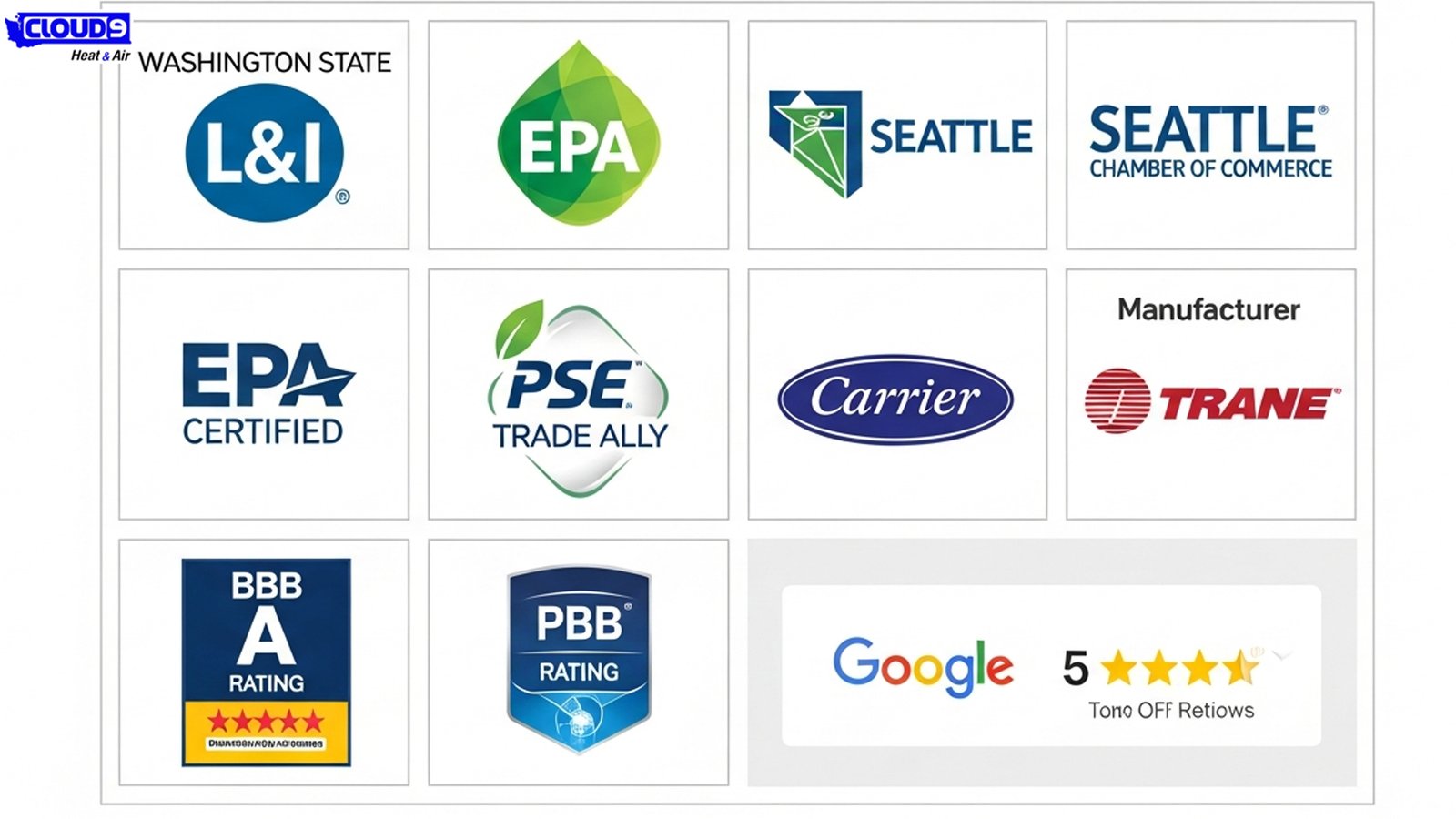
If you made it this far, you now know the eight red flags that separate a quality HVAC installation from a bad or unsafe one. Most Seattle homeowners never hear this stuff because too many contractors don’t want you asking the right questions.
But now you can.
Before you hire anyone, make sure they’re licensed through WA L&I, they perform a full Manual J, they pull permits, and they understand the refrigerant changes.
Get two or three quotes, compare what each contractor includes, and trust your gut. A lower price upfront often leads to a much higher price later.
Ready to work with a Seattle HVAC contractor who actually does things the right way?
Cloud 9 Heat & Air has 19+ years of experience, offers a free installation quality assessment so you can make a confident decision before you spend a dime. Schedule Your Free Session Now!